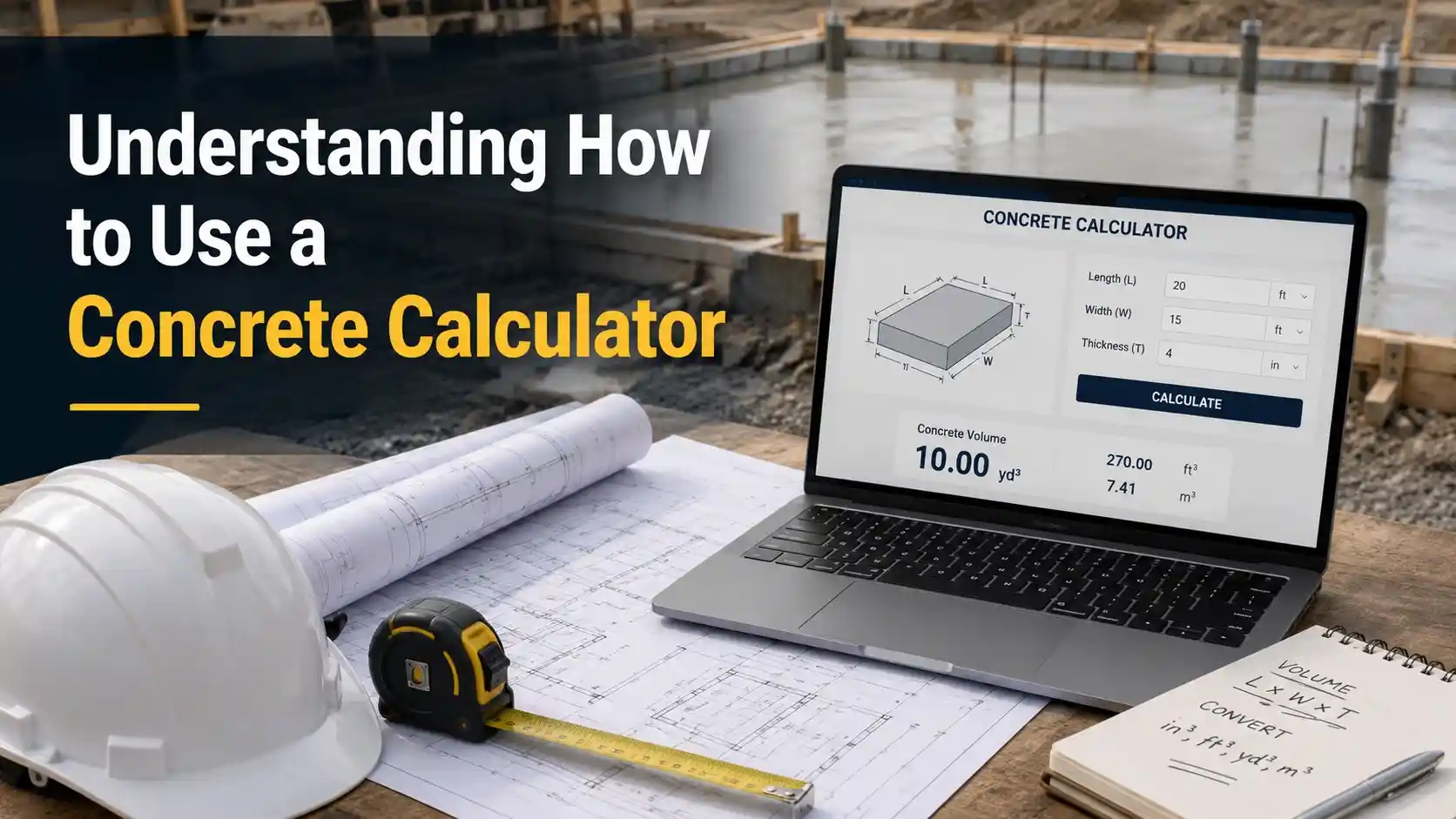
Embarking on a masonry project can feel overwhelming, whether you are pouring a simple backyard patio, laying a foundation, or setting a few fence posts. The secret to a successful, stress-free pour lies in Understanding How to Use a Concrete Calculator. If you are struggling with how to work out concrete requirements without overbuying or running dangerously short mid-pour, relying on a digital concrete calculator is your absolute best bet.
Here is a comprehensive guide to measuring, calculating, and estimating your next concrete project like a seasoned pro.
Before you punch numbers into an app, you need to know exactly how to measure for concrete. For standard square or rectangular projects, you will need the length, width, and depth. Pay special attention to your residential concrete slab thickness. While a standard walking patio might only require 4 inches of depth, a driveway will typically need 6 inches. Always consider the slab depth material impact—adding just one inch of thickness across a wide slab drastically changes your total volume requirements.
The foundational concrete calculator formula simply multiplies the length by the width by the depth (in feet) to find your total cubic feet. Because concrete is sold by the cubic yard, you must then apply a standard cubic feet to yards conversion by dividing that total by 27. This simple math is the core of how to determine concrete volume, effectively answering the common beginner question: how do i calculate yards of concrete? Once you run this equation, you can easily determine concrete yardage for your order.
Navigating Bag Sizes: The Concrete Bag Calculator Essentials
For small to medium DIY jobs, buying individual bags is usually the most practical route. Using a bag concrete estimator or a dedicated concrete bag calculator makes the process effortless. The most frequent question DIYers ask is, “how many bags of concrete do i need?” To figure this out accurately, you first need to establish how many bags of concrete in a yard.
Let’s break down the math by common bag sizes:
- 80 lb Bags: The standard 80 lb bag of concrete cubic feet yield is approximately 0.60. If you are specifically looking up how many cubic feet in 80 pound bag of concrete, remember that 0.60 figure. So, how many 80 pound bags of concrete in a yard? You will need exactly 45 bags. (This also answers the common queries of how many 80 lb bags of concrete in a yard and how many 80lb bags per yard). Conversely, if you are asking, for 1 80 lb bag of concrete how many yards does it yield? It produces roughly 0.022 cubic yards.
- 60 lb Bags: If you prefer slightly lighter lifting, you might wonder how many cubic feet in 60 lb bag of concrete? Each yields about 0.45 cubic feet. For a full yard, you must calculate how many 60 pound bags of concrete in a yard (or how many 60lb bags in a yard of concrete)—which equals precisely 60 bags. As a quick visual reference: what will 30 60lb bags of concrete fill? Exactly half a cubic yard!
- 50 lb Bags: A standard 50 lb bag of concrete yields about 0.37 cubic feet. These are generally reserved for very small post hole jobs, quick repairs, or light touch-ups.
Buying in Bulk: Pallets and Ready Mix
If you are tackling a mid-sized job, buying bag by bag is inefficient; you will want to buy by the pallet. You will likely ask, how many concrete bags on a pallet? Depending on the manufacturer, a pallet usually holds between 42 and 56 bags. More specifically, how many 80lb bags of concrete on a pallet? Standard home improvement stores usually stack 42 bags per pallet. Therefore, if you are calculating how many 80 pound bags of concrete on a pallet, knowing it is 42 bags tells you that one full pallet is just slightly under one complete cubic yard (45 bags).
For larger projects like driveways or full foundations, you must weigh the pros and cons of ready mix vs bag concrete. Mixing 45 bags by hand is exhausting. For projects requiring over a yard or two, utilizing a ready mix calculator to order a delivery truck directly to your site is highly recommended.
Special Projects: Posts, Tubes, Steps, and Irregular Shapes
Not all projects are flat, simple squares. Different structures require specific mathematical approaches:
- Fence Posts and Footings: If you are setting fences, a dedicated post hole concrete calculator takes the guesswork out of finding the precise concrete volume for fence posts. Similarly, if you are building deck footings, you need to calculate the volume for cylindrical sona tubes by using the formula for the volume of a cylinder (π × radius² × height).
- Stairs and Walls: When you need to calculate concrete for steps, the easiest method is to break the staircase down into individual rectangular prisms, calculate each, and add them together. For building retaining walls, a cement block calculator helps you determine both the block count and the core-fill cement needed.
- Custom Slabs: Measuring irregular concrete slabs can be tricky. Break the complex shape down into smaller, manageable squares, rectangles, and right triangles. Find the volume of each section using a standard concrete volume calculator and sum up the totals.
Planning Your Budget and Site Preparation
Calculating volume is just the first step; figuring concrete cost is equally vital. Utilizing specialized tools like a driveway concrete cost estimator or a general concrete pad cost calculator will help you budget effectively for both materials and delivery fees.
Before the concrete truck arrives, ensure your site is completely prepped. This involves estimating gravel sub-base volume to ensure proper drainage and load-bearing capacity. Additionally, calculating rebar reinforcement needs based on the size of the slab is critical for long-term structural integrity. Don’t forget about determining concrete PSI requirements before you order. A heavy-duty driveway needs a much higher PSI (typically 4000) than a light-traffic garden pathway (around 2500 to 3000 PSI).
Pro Tips for Preventing Estimation Errors
The golden rule of masonry is practicing strict concrete estimation error prevention. Even the most perfect mathematical calculations can fall short in the real world due to uneven ground or spilling. The most critical step you can take is accounting for concrete spillage waste and sub-grade settling. Industry standard dictates that you should always add an extra 5% to 10% to your final calculated volume.
By familiarizing yourself with these formulas and leveraging digital calculators, you can confidently estimate any project. Whether you are ordering a full ready-mix truck or just grabbing a few bags from the hardware store, you now have the knowledge to measure, calculate, and pour with absolute precision.