Before You Go — Get BRAND BOA Updates Top Products, Shed Plans & Estimating Tips
Join homeowners, DIY builders & contractors
Subscribe to receive construction product recommendations, shed plan updates, BOQ tips, and useful buying guides for tools, materials, finishes, and building essentials. We’ll help you discover selected products from trusted USA suppliers and share practical ideas to plan, price, and build smarter.
The modern construction site is a high-stakes, fast-paced environment. With multimillion-dollar budgets, stringent safety regulations, and complex supply chains, the industry demands highly skilled leaders who can steer projects from blueprint to final inspection. If you are currently working in the field and looking to elevate your career, becoming a certified construction manager (CCM) is one of the most powerful steps you can take.
Whether you are overseeing commercial high-rises, residential developments, or civil engineering feats, earning a specialized construction management certification proves your expertise, dedication, and leadership.
In this article, we will explore why formal certification is becoming the industry standard, break down the core benefits of earning your credential, and provide a clear roadmap for your professional development.
Table of Contents
What is a Certified Construction Manager?
A certified construction manager is a professional who has met rigorous educational and experience requirements and passed a comprehensive examination demonstrating their ability to manage complex building projects.
The CCM designation is widely considered the gold standard in the industry. It proves that a manager is deeply familiar with the CMAA standards of practice (Construction Management Association of America), which govern ethical and efficient project execution. Furthermore, the CCM is highly respected because it is one of the few ANSI accredited professional credentials in the building industry, meaning it meets strict international standards for personnel certification.
Earning this title shows employers, clients, and stakeholders that you possess the technical knowledge and the strategic foresight required to deliver projects on time, within budget, and to the highest quality standards.
Why Pursue a Construction Management Certification?
You might be wondering if the time and financial investment are truly worth it. The short answer is yes. The value of construction management credentials cannot be overstated in today’s competitive job market. Here is why industry professionals are flocking to these programs.
Elevating Your Earning Potential
One of the most immediate benefits of certification is the financial return. The salary for credentialed construction professionals is consistently higher than that of their non-certified peers. Because certified managers are trusted with larger budgets and more complex projects, employers are willing to pay a premium for their proven expertise. Many certified professionals report salary increases of 10% to 20% shortly after obtaining their credentials, alongside access to better bonuses and profit-sharing opportunities.
Standing Out in a Competitive Market
The construction industry is heavily reliant on trust. When owners and developers invest capital into a new build, they want peace of mind. Earning your certified construction manager certification acts as a third-party validation of your skills. It instantly separates your resume from the stack.
If you are looking to map out a long-term construction management career advancement path, this credential acts as a master key. It opens doors to executive-level roles, specialized consultancy positions, and opportunities to lead high-profile regional or national projects.
Key Benefits of Earning Your CCM Credential
Beyond the salary bump and the impressive resume addition, preparing for and achieving your credential equips you with a formidable toolkit of skills.
Mastering Standardized Project Delivery Methods
A major advantage of formal certification is gaining a deep understanding of standardized project delivery methods. Whether a project utilizes Design-Bid-Build, Design-Build, or Construction Management at Risk (CMAR), certified managers know how to navigate the nuances of each. This knowledge allows you to align the delivery method with the owner’s goals, ensuring streamlined communication, fewer contract disputes, and an optimized workflow from day one.
Enhancing Leadership and Risk Management
Managing a job site requires more than just technical know-how; it requires exceptional people management. Certification programs heavily emphasize the leadership skills for project executives, teaching you how to motivate diverse teams, manage stakeholder expectations, and resolve conflicts swiftly.
Equally important is the ability to foresee and prevent disasters. A certified manager excels at mitigating construction project risks. From anticipating supply chain bottlenecks and weather delays to ensuring strict OSHA compliance, credentialed managers are trained to identify vulnerabilities early and implement robust contingency plans.
Advanced Cost Management
Budget overruns are the bane of the construction industry. Advanced certification trains you in rigorous estimating, budgeting, and financial tracking. This is particularly vital when dealing with cost control in infrastructure projects, where public funds, strict regulatory oversight, and massive scale make financial precision absolutely critical. A certified manager knows how to utilize value engineering to save money without compromising the project’s integrity.
CCM vs. PMP: Understanding the Landscape
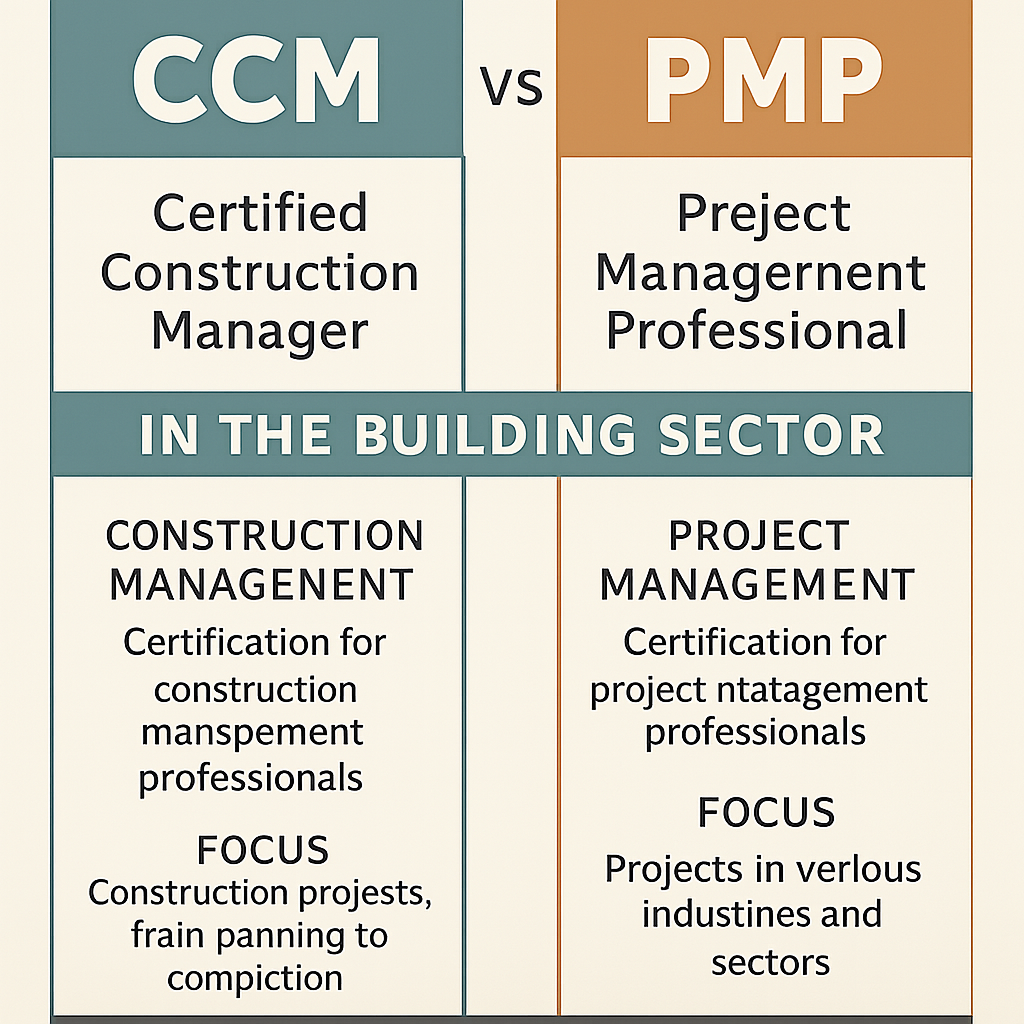
When exploring certifications, many professionals find themselves doing a CCM vs PMP comparison. While both are highly respected, they serve different purposes.
The Project Management Professional (PMP) is a general credential applicable to IT, healthcare, finance, and construction. Conversely, the CCM is tailor-made for the built environment.
This brings up the common debate of the construction manager vs project manager.
Project Manager (PM): Often handles the administrative side of a project, including scheduling, procurement, and high-level budgeting, but may not have deep technical building expertise.
Construction Manager (CM): Deeply entrenched in the physical execution of the build. They understand site logistics, structural engineering principles, and trade coordination.
While a general construction project management certification is a great stepping stone, pursuing the specialized CCM provides unmatched authority specifically on the job site.
How to Get Certified: Requirements and Preparation
If you are ready to take the leap, you need to understand the structural path to certification. Getting certified requires planning, experience, and rigorous study.
Navigating the Requirements
First, you must familiarize yourself with the CMAA professional certification requirements. The credentialing body, the Construction Management Certification Institute (CMCI), sets strict rules for applicants.
To meet the CMCI exam eligibility requirements, you typically need a combination of formal education (such as a bachelor’s degree in construction management, architecture, or engineering) and a minimum of 48 months of “responsible-in-charge” experience. This means you must prove you have actively led a project through its major phases: pre-design, design, procurement, construction, and post-construction.
Educational Pathways and Preparation
If you lack the formal educational background but have the field experience, don’t worry. Many universities and trade organizations offer robust construction management certificate programs that can help bridge the gap.
For working professionals who cannot afford to take time away from the job site, pursuing a construction management certification online is an incredibly popular and flexible option. These digital programs allow you to study blueprint reading, contract law, and estimating during your off-hours.
When it comes to preparing for professional construction credentials, action and consistency are key. Here are a few practical tips:
Join a Study Group: Connect with local CMAA chapters to find peers who are also preparing for the exam.
Take Practice Exams: The exam covers a vast amount of material, including time management, quality management, and contract administration. Practice tests will highlight your weak spots.
Find a Mentor: Speak to someone who already holds the credential. They can offer invaluable insights into what the exam board is truly looking for.
Your Construction Management Career Guide
Consider this your ultimate construction management career guide: never stop learning. The industry is constantly evolving with the introduction of Building Information Modeling (BIM), drone site-surveying, and green building standards. Earning your credential is not the finish line; it is a foundation.
Many professionals aggressively seek out a CCM certification; construction firms, in turn, actively recruit these forward-thinking individuals. By maintaining your credential through continuing education credits, you ensure that your knowledge remains sharp and relevant as technology and building codes advance.
Conclusion
The journey to becoming a certified construction manager requires dedication, significant field experience, and rigorous studying. However, the benefits drastically outweigh the effort. From mastering advanced project delivery methods to unlocking lucrative salary increases, the return on investment is transformative for your career.
By pursuing this prestigious path, you not only elevate your own professional standing but also contribute to a safer, more efficient, and more innovative building industry. Take the first step today—review the eligibility requirements, explore online study programs, and start building the foundation for the most rewarding phase of your construction c
Newsletter Updates
Enter your email address below and subscribe to our newsletter