Before You Go — Get BRAND BOA Updates Top Products, Shed Plans & Estimating Tips
Join homeowners, DIY builders & contractors
Subscribe to receive construction product recommendations, shed plan updates, BOQ tips, and useful buying guides for tools, materials, finishes, and building essentials. We’ll help you discover selected products from trusted USA suppliers and share practical ideas to plan, price, and build smarter.
Whether you are pouring a small patio, setting posts for a new privacy fence, or repairing a damaged sidewalk, properly estimating your materials is the foundation of any successful DIY masonry project. If you overbuy, you waste money and strain your back moving heavy bags. If you underbuy, you risk a compromised pour, as concrete needs to cure as a single, continuous slab.
For most homeowners and contractors, the most common question that arises during the planning phase is: how many cubic feet in 60 pound bag of concrete?
Understanding exactly how much material you get per bag is critical for mapping out your costs and labor. In this comprehensive guide, we will break down the math, share coverage charts, and provide practical examples for calculating exactly what you need for your next project.
The Short Answer: What is the Volume?
To get right to the point: there are 0.45 cubic feet in 60 pound bag of concrete.
But why is that the case? The volume of concrete is dictated by its density. When fully mixed with water and cured, standard concrete weighs approximately 133 pounds per cubic foot. If you divide the 60-pound dry weight by the 133-pound density of a cubic foot, you get a concrete yield per 60 lb bag of roughly 0.45 cubic feet.
It is important to remember that this number represents the total volume of wet concrete per bag once it is properly mixed with water. Dry concrete fluffs up and contains air, so the dry volume in the sack will look slightly different than the dense, wet mud you ultimately pour into your forms.
Understanding Concrete Bag Dimensions and Weight
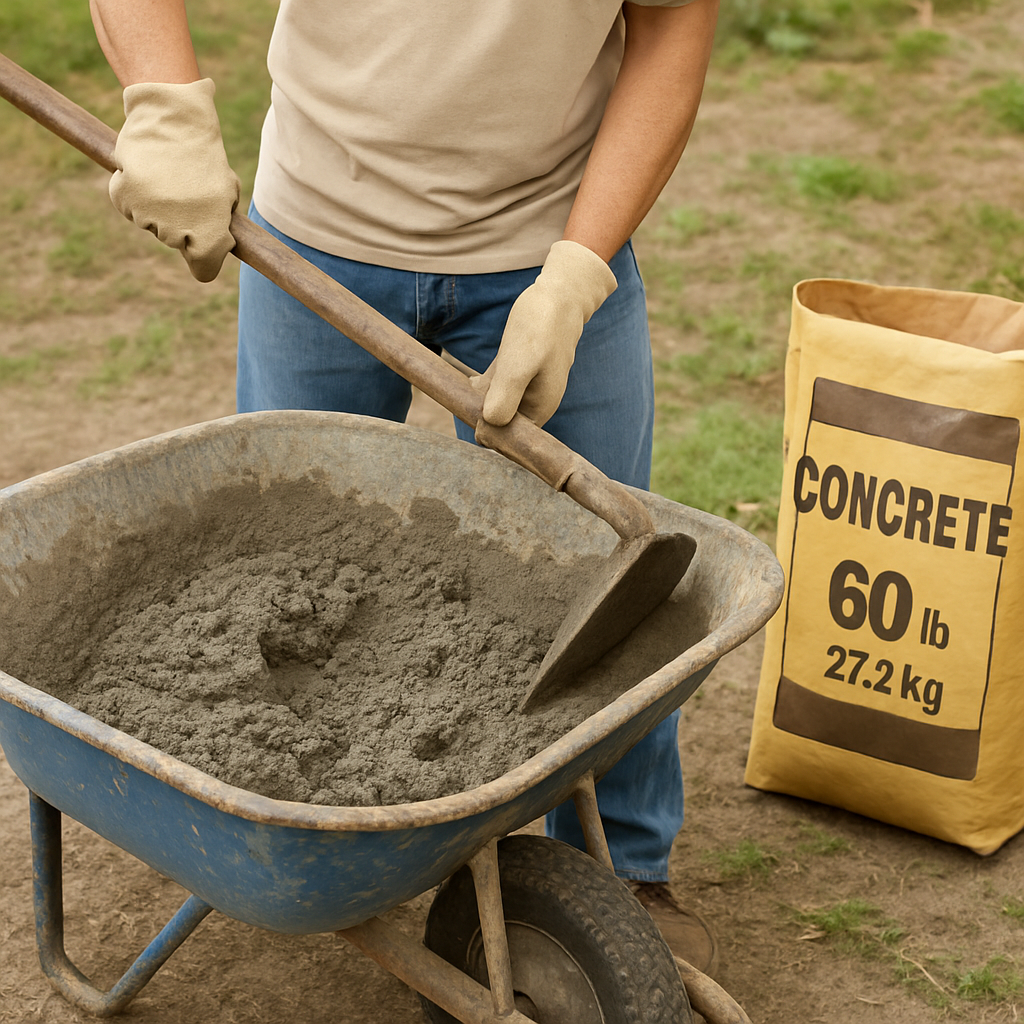
When you walk down the aisles of a home improvement store, you will notice pallets stacked high with heavy paper sacks. The standard concrete bag dimensions for a 60-pound bag are generally around 21 inches long, 12 inches wide, and 4 inches thick. However, measuring the physical bag will not give you the true concrete bag volume because the dry powder compacts down once hydrated.
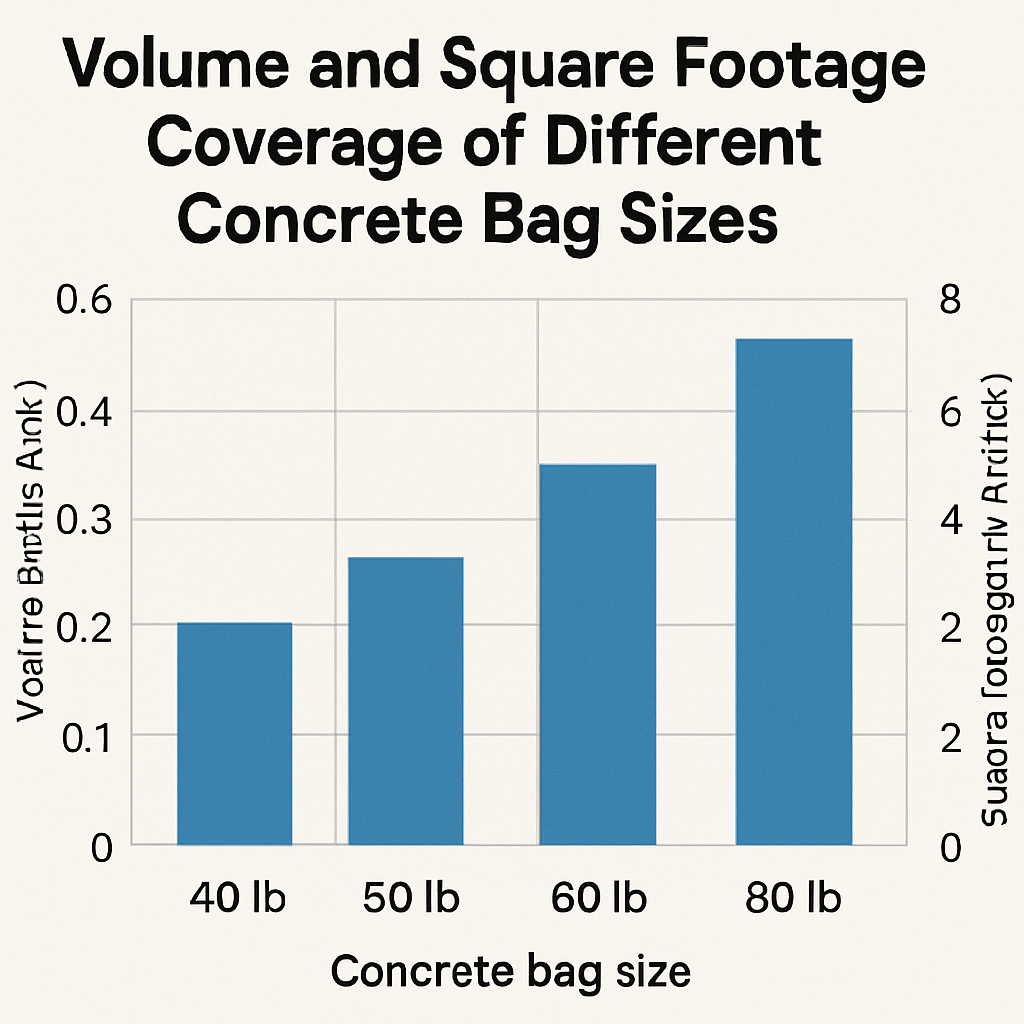
To make your planning easier, here is a quick concrete weight to volume conversion chart for the most common bag sizes found at hardware stores:
40 lb bag: Yields approximately 0.30 cubic feet
50 lb bag: Yields approximately 0.37 cubic feet
60 lb bag: Yields approximately 0.45 cubic feet
80 lb bag: Yields approximately 0.60 cubic feet
60 lb vs 80 lb Quikrete Coverage Comparison
You might wonder whether you should buy 60 lb or 80 lb bags. When doing a 60 lb vs 80 lb quikrete coverage comparison, an 80-pound bag gives you 0.60 cubic feet, meaning you will need fewer bags overall to complete a job. However, 60 pound concrete is significantly easier to lift, carry, and maneuver. For solo DIYers, saving your back from the grueling strain of 80-pound sacks often makes the 60-pound bags the superior choice, even if you have to mix a few extra batches.
How to Calculate Your Concrete Needs
Calculating the amount of material you need requires finding the total cubic footage of your project and dividing it by the yield of your chosen bag.
The formula for cubic footage is: Length (in feet) × Width (in feet) × Depth (in feet) = Total Cubic Feet
Once you have that number, you can use a concrete bag coverage calculator by weight, or simply divide your total cubic feet by 0.45. Let’s look at some real-world examples.
Example 1: How Many Bags of Concrete for 4×4 Slab?
Let’s say you are pouring a small pad for a trash can enclosure or an air conditioning unit.
Total Volume: 100 sq ft × 0.33 ft = 33.3 cubic feet.
Bag Count: 33.3 ÷ 0.45 = 74 bags.
With a 10% buffer, you would need about 82 bags.
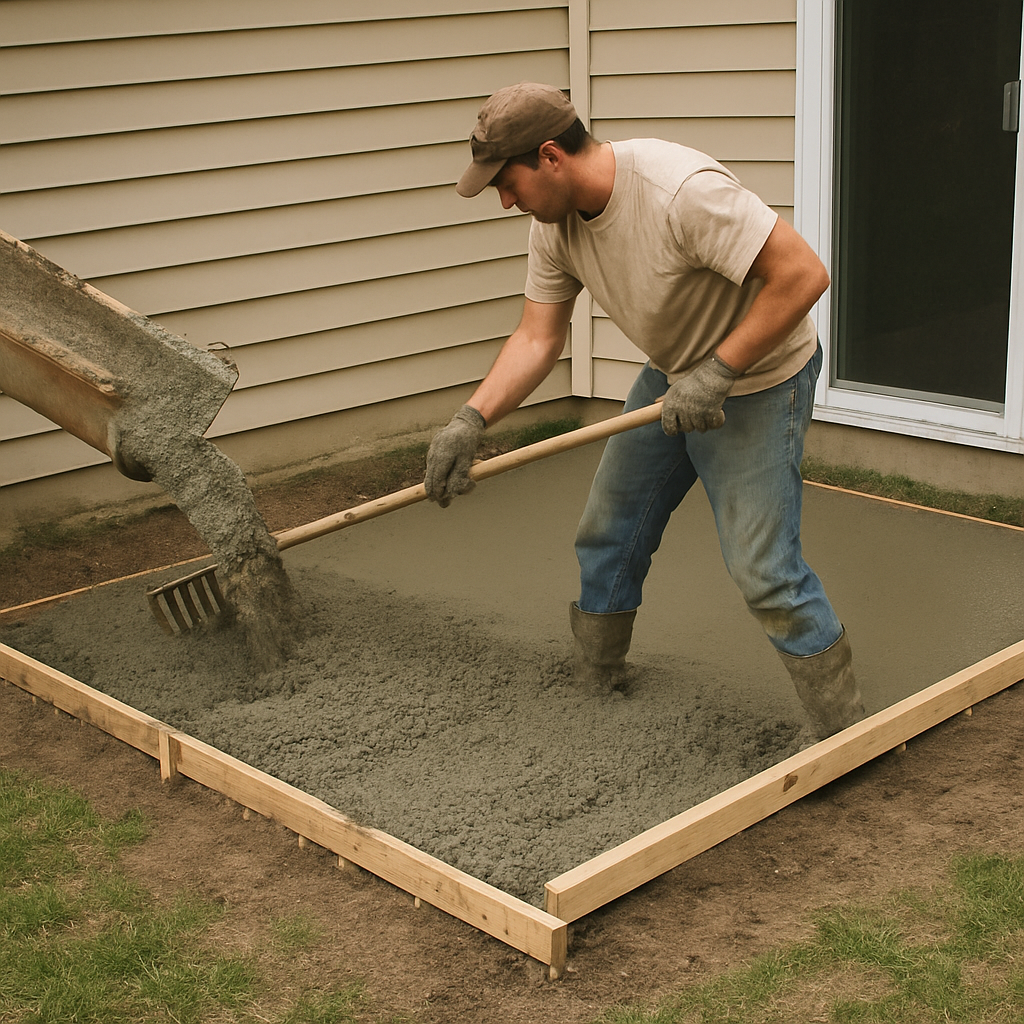
To simplify your estimates based on area alone, remember this rule of thumb for the square footage coverage for 4 inch slab: a single 60-pound bag will cover approximately 1.35 square feet at 4 inches thick.
Setting Posts: Fence, Deck, and Pergola Footings
Slabs aren’t the only projects that require concrete. Many DIYers need to know the quantity of concrete needed for fence post installations.
Determining bag count for post hole footings depends entirely on the diameter of your hole and the depth of your frost line. A general rule for fence posts is that the hole should be three times the width of the post and a depth equal to one-third to one-half of the post’s above-ground height.
For a standard 4×4 wooden post, you will typically dig a 10-inch diameter hole that is 24 inches (2 feet) deep.
A 10-inch diameter hole that is 2 feet deep has a volume of roughly 1.1 cubic feet.
Subtract the volume of the wooden post sitting in the hole (about 0.22 cubic feet).
You need approximately 0.88 cubic feet of concrete per hole.
0.88 ÷ 0.45 = 1.95 bags.
So, you should plan for exactly two 60-pound bags per standard fence post.
Achieving the Perfect Mix
Buying the right amount of concrete is only half the battle; mixing it correctly ensures the longevity of your project. The standard concrete mix water ratio for 60lb bag is usually around 2.5 to 3 quarts (about 2.4 to 2.8 liters) of clean water.
It is vital not to overwater your mix. Soupy concrete might be easier to pour and level, but excess water dilutes the cement paste, dramatically weakening the final cured product and leading to surface flaking or cracking. Add about two quarts of water initially, mix thoroughly, and then slowly add the rest until the concrete reaches a thick, oatmeal-like consistency. It should hold its shape when squeezed in a gloved hand without dripping excess water.
Additionally, pay attention to the specific type of mix you buy. Standard concrete is fine for most jobs, but if you are pouring a high-traffic area, you may opt for a high-strength variety. Fortunately, the high strength premixed concrete yield is virtually identical to standard mixes, so you can still rely on the 0.45 cubic feet measurement for your calculations.
Large Projects: Bagged Concrete vs. Delivery
When calculating your materials for larger projects, you will eventually hit a threshold where mixing bags by hand becomes impractical. This brings us to calculating cubic yardage from 60 pound bags.
Concrete companies sell their product by the cubic yard. One cubic yard is equal to 27 cubic feet. Since we know exactly how many cubic feet in 60 pound bag of concrete (0.45), we can divide 27 by 0.45 to find that it takes exactly sixty 60-pound bags to make one cubic yard of concrete.
This math is crucial when deciding between ordering ready mix vs using bagged concrete.
Use Bagged Concrete if: Your project requires less than 1 to 1.5 cubic yards (fewer than 60 to 90 bags). Mixing this amount over a weekend with a rented mechanical mixer is highly feasible for a dedicated DIYer.
Order Ready Mix if: Your project exceeds 1.5 cubic yards. The physical labor of unloading, opening, and mixing 100+ bags of concrete is exhausting. A delivery truck can pour a patio in 20 minutes that would take you 12 hours to mix by hand.
Best Practices for Successful Pours
Whether you are pouring footings or flatwork, adhering to industry standards will protect your investment.
When establishing the thickness of concrete for residential walkways, 4 inches is the absolute minimum standard. This thickness is more than sufficient for foot traffic, bicycles, and lawnmowers. However, if you are pouring a driveway or an area that will bear the weight of a vehicle, you must increase the thickness to at least 5 or 6 inches and include steel rebar or heavy wire mesh for structural reinforcement.
Furthermore, always spend adequate time on your sub-base. Dig out the topsoil, lay down at least 2 to 4 inches of compactable gravel (like crushed run), and tamp it firmly. Pouring your 60-pound bags directly onto soft dirt will almost guarantee the concrete will crack and sink as the ground freezes, thaws, and settles.
Final Thoughts
Thorough preparation is the secret to stress-free masonry work. By knowing precisely how many cubic feet in 60 pound bag of concrete, you can approach your home improvement tasks with confidence.
Remember the golden rule of 0.45 cubic feet per bag, always measure your project carefully (Length × Width × Depth), and never forget to factor in an extra 10% for spillage, uneven digging, and peace of mind. Armed with this knowledge, you are ready to frame up your forms, turn on the hose, and start mixing.
Newsletter Updates
Enter your email address below and subscribe to our newsletter