

Mastering Contractor Tender BOQ for Successful Bids
In the highly competitive world of commercial and residential building, winning a project is only half the battle; the real victory lies in completing it profitably. At the very heart of this process is the Contractor Tender BOQ (Bill of Quantities). If you want to succeed in construction bidding, mastering this foundational document is absolutely non-negotiable.
A well-prepared BOQ is the bridge between a client’s architectural vision and the contractor’s financial reality. It allows contractors to provide precise, competitive contractor quotes while safeguarding their profit margins. Whether you are an estimator, a project manager, or a business owner, understanding the ins and outs of a contractor tender boq will drastically improve your win rate and project profitability.
In this comprehensive guide, we will explore exactly what this document entails, how to price it accurately, and how to navigate the complex risks associated with tender submissions.

What is a Contractor Tender BOQ?
A Bill of Quantities (BOQ) is a detailed document used in tendering in the construction industry. It breaks down a project into measurable, itemized components—such as materials, parts, and labor—complete with their respective quantities.
When issued as part of a tender package, it serves as the primary pricing schedule for construction bids. Instead of contractors guessing how many cubic meters of concrete or square meters of drywall are required, the BOQ provides a level playing field. Everyone bids based on the exact same quantities, meaning the competition comes down to efficiency, supplier relationships, and resource management.
The Role of Professionals in the Process
Traditionally, the role of quantity surveyor in procurement is to draft the initial BOQ on behalf of the client or employer. They analyze the architectural and engineering drawings to extract precise measurements. Once finalized, this blank BOQ is handed over to competing contractors, who then fill in their rates to generate a final tender price.
Preparing and Measuring: The Foundation of a Great Bid
Sometimes, contractors are required to build or verify their own BOQ, especially in design-and-build scenarios. If you are wondering how to prepare a bill of quantities for tendering, it requires a methodical approach.
Here is a brief step by step guide to construction cost estimation when working with a BOQ:
- Review the Tender Documents: Before counting a single brick, thoroughly review the blueprints, specifications, and scope of work.
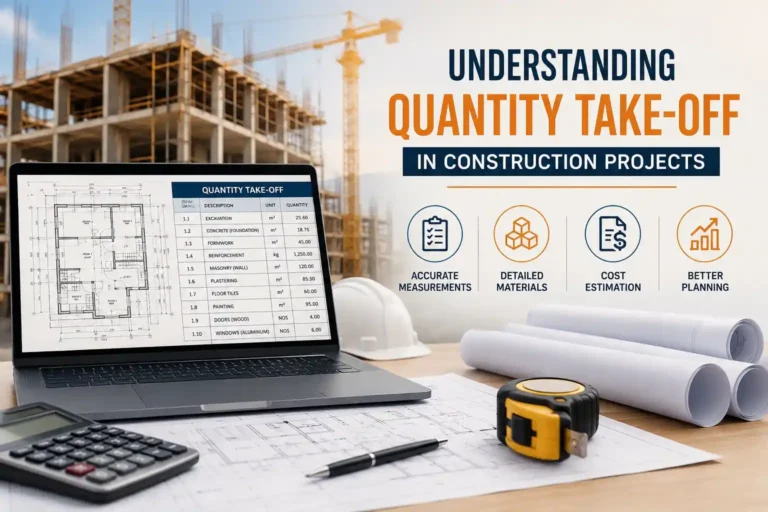
- Execute the Take-Off: The material take-off process for accurate bidding is where estimators quantify every physical element required for the build. This involves measuring lengths, areas, and volumes directly from the plans.
- Apply Measurement Rules: To ensure consistency and avoid disputes, quantities must be measured according to industry standards. In the UK and many international markets, professionals rely on the NRM2 rules of measurement for building works. Alternatively, other regions might use a localized standard method of measurement for construction works.
- Structure the BOQ: Group the measured items logically (e.g., Substructure, Superstructure, Finishes) so the pricing phase is streamlined.
Pricing the BOQ: Turning Quantities into Quotes
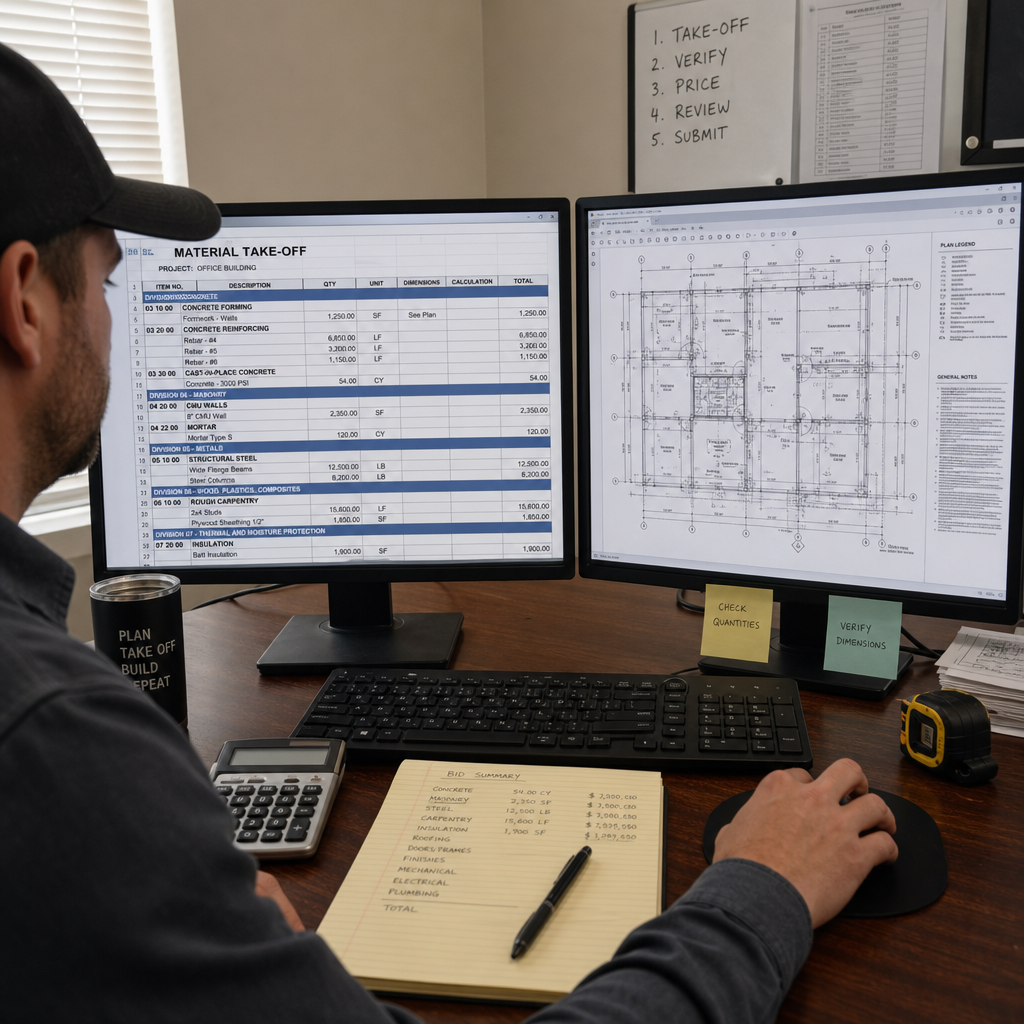
Once the quantities are established, the next critical phase is pricing. This is where estimators spend the bulk of their time.
Mastering Unit Rates
Calculating unit rates for tender submissions is a delicate balancing act. A unit rate is not just the cost of raw materials. To be accurate and profitable, a unit rate must incorporate:
- Materials: The cost of the physical product, including delivery and wastage.
- Labor: The cost of the workforce required to install the material, factoring in productivity rates.
- Plant/Equipment: Cranes, excavators, or specialized tools needed for the task.
- Overheads and Profit (O&P): A percentage added to cover head office costs and the contractor’s margin.
By strictly adhering to itemized pricing for commercial construction projects, contractors can maintain a clear view of where their money is going. It also allows clients to easily compare bids line-by-line.
Managing Expectations
A meticulously priced BOQ helps bridge the gap between initial expectations and reality. By comparing the client’s pre-tender estimate vs actual project cost derived from contractor bids, project stakeholders can identify if a project is over budget before a single shovel hits the dirt. If the contractor’s BOQ comes in significantly higher than the estimate, value engineering can be applied to specific itemized lines to bring costs down.
Navigating Contracts and Managing Risk
The construction industry is inherently risky. When pricing a tender, understanding your legal and financial liabilities is just as important as knowing the cost of concrete.
Contract Types and BOQs
One of the most common debates in procurement is the choice between a lump sum contract vs bill of quantities contract.
- Lump Sum Contract: The contractor agrees to complete the project for a fixed total price. If the client’s initial quantities were wrong, the contractor usually bears the risk (unless the design changes).
- BOQ Contract (Re-measured): The contractor is paid based on the actual quantities installed on-site, using the unit rates provided in the tender BOQ.
This brings up a highly debated question during disputes: who is responsible for quantity measurement errors? In a standard BOQ contract where the client’s quantity surveyor provided the document, the client generally bears the risk of errors in the quantities. If the BOQ says 100 doors, but the drawings actually require 120, the contractor will be paid for the extra 20 doors at the agreed BOQ rate. However, if the contractor was responsible for creating the BOQ under a design-and-build lump sum agreement, the contractor will likely have to absorb the cost of those extra doors.

Handling Discrepancies
Even the best quantity surveyors make mistakes. When handling discrepancies in tender pricing schedules—such as a mismatch between the drawings and the BOQ—it is crucial to act transparently.
- Raise an RFI (Request for Information): Do not guess. If a specification is missing, ask the client for clarification before submitting your bid.
- Qualify Your Bid: If clarification isn’t provided in time, clearly state in your tender cover letter what assumptions you made when pricing that specific BOQ line item.
Best Practices for Winning and Profitable Bids
To thrive in modern procurement, contractors must modernize their estimation workflows. Here are actionable tips to ensure your bids are both competitive and secure.
1. Standardize Your Workflows
One of the best ways to speed up your estimation process is by taking advantage of the benefits of using standardized BOQ templates. Using a consistent format (often formatted in Excel or specialized estimating software) ensures that you never accidentally skip a critical section like site preliminaries, temporary works, or final clean-up costs. Standardization creates a reliable checklist that protects your profit margins.
2. Double-Check for Estimation Errors
A simple misplaced decimal point can turn a profitable job into a company-ending disaster. Avoiding estimation errors in bid documents requires a multi-tiered review process.
- Peer Review: Always have a second estimator or project manager review the final BOQ before submission.
- Check Formulas: If using spreadsheets, verify that all sum formulas capture every row.
- Historical Data: Compare your final unit rates against similar past projects. If your concrete rate is suddenly 30% cheaper than last year, you likely missed a component (like formwork or rebar).
3. Embrace Technology
Gone are the days of highlighters and scale rulers. Modern contractors use digital take-off software and cloud-based estimating platforms. These tools integrate the drawings directly with the BOQ, meaning if a wall is deleted in a digital drawing revision, the material quantities in your BOQ automatically update, drastically reducing human error.
Conclusion
The Contractor Tender BOQ is far more than just a list of materials and prices; it is a strategic tool that dictates the financial health of a construction project. From understanding the strict rules of measurement to calculating airtight unit rates and navigating contract risks, mastering the BOQ process empowers contractors to bid with absolute confidence.
By prioritizing accurate take-offs, utilizing standardized templates, and maintaining clear communication regarding discrepancies, construction firms can submit highly competitive, profitable bids. Ultimately, a well-executed BOQ doesn’t just help you win the tender—it sets the stage for a smooth, transparent, and successful construction phase.